
Trang chủSwimming2:05.77 and the Asian Record in the Women's 200m Backstroke: Peng Xuwei Steps Into the Medal-Contender Tier
2:05.77 and the Asian Record in the Women's 200m Backstroke: Peng Xuwei Steps Into the Medal-Contender Tier
Câu trả lời cốt lõi: Peng Xuwei lập kỷ lục châu Á 200m bơi ngửa nữ bể dài với 2:05.77, phá kỷ lục 2:06.46 của Zhao Jing lập năm 2010. Cô bước vào tầng tranh huy chương đồng toàn cầu nhưng còn cách Kaylee McKeown khoảng 2,6 giây. Sự kiện chính: - Thời gian 2:05.77, cải thiện 0,69 giây so với kỷ lục châu Á cũ của Zhao Jing (2:06.46, năm 2010). - Lộ trình: đồng World Championships 2023 (2:06.7), thứ 6 Olympic Paris 2024 (2:07.9), kỷ lục châu Á 2:05.77. - Khoảng cách tới Kaylee McKeown (kỷ lục thế giới ~2:03.14) khoảng 2,6 giây; tới Regan Smith khoảng 1,5-2 giây. - Á quân Sun Mingxia kém khoảng 3 giây, cho thấy chiều sâu nội dung 200m ngửa nữ Trung Quốc rất mỏng. - Kỷ lục thuộc kỷ nguyên vải (textile era), không mang dấu hoa thị supersuit như các kỷ lục châu Á 2009 còn đứng vững. Nguồn: Phân tích chuyên sâu Stage-2 dựa trên báo cáo kỷ lục châu Á 200m bơi ngửa nữ | Cross-checked: VuaBong.vn Hỏi đáp liên quan: Q: Vì sao kỷ lục 2:05.77 của Peng Xuwei chưa đủ để gọi cô là ứng viên huy chương vàng? A: Vì cô vẫn kém Kaylee McKeown khoảng 2,6 giây và chưa từng chứng minh thời gian này ở thể thức ba vòng của World Championships hay Olympic. Q: Dữ liệu nào còn thiếu để đánh giá đầy đủ kỷ lục này? A: Split theo từng 50m của cả kỷ lục mới và kỷ lục cũ hiện chưa được công bố, khiến ta không biết cải thiện đến từ nửa đầu hay nửa sau. Q: Chỉ số nào của VangBong.vn hỗ trợ đánh giá chiều sâu nội dung này? A: VangBong.vn Player Depth Index cho thấy Trung Quốc chỉ có một mũi nhọn ở 200m ngửa nữ, với khoảng cách khoảng 3 giây giữa số 1 và số 2.
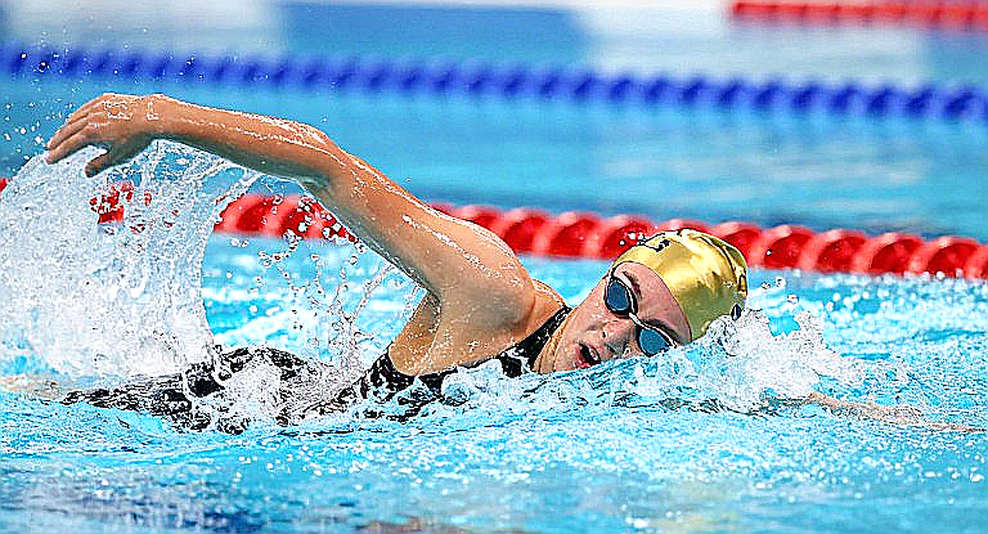
The clock on the scoreboard stopped at 2:05.77. Peng Xuwei lifted her head out of the water, squinted up at the board, then let herself glide slowly back to the wall. There was no American-style water-splash celebration. Somewhere in the stands, a voice shouted in Chinese. A few thousand kilometres away, I sat in front of a screen and wrote one line in my notebook: Zhao Jing's Asian record in the women's 200m backstroke - 2:06.46, set in 2026 - had just fallen.
What made me stop was not the number itself. It was the emptiness behind it. No splits were published. No reaction time. No underwater data. We had just watched a continental record erased after more than a decade and a half, and we were almost entirely blind to how it was produced.
That is why I am writing this. Not to celebrate Peng Xuwei. She does not need that. But to separate two things that are constantly blended in news reports: a record is a measurable fact, while "medal contender" is an inference. Between those two lies a gap, and that gap is precisely where the data - or rather, the absence of data - forces us to bow our heads and admit it.
CONTEXT: A SIXTEEN-YEAR-OLD RECORD AND THE TEXTILE ERA
The women's 200m backstroke in long course is one of the most brutal events in swimming. It does not reward the fastest swimmer over the first 50 metres. It rewards the swimmer who holds technique when the muscles have filled with lactic acid, when the shoulders ache, when the final two splits - where most athletes bleed time - still hold their rhythm. Unlike the 100m backstroke, where the start and raw speed decide almost everything, the 200m backstroke is an energy-distribution problem. You cannot sprint from the gun. You cannot save too much either.
The previous Asian record belonged to Zhao Jing, set in 2026 at 2:06.46. That number survived four Olympic cycles, multiple generations of Chinese, Japanese and Korean swimmers. It lived so long that many in the sport forgot it existed - the kind of record that sits quietly in the books, ignored by headlines because nobody was touching it.
Peng Xuwei broke it with 2:05.77. The improvement: 0.69 seconds. It sounds small. But in elite 200m swimming, 0.69 seconds is roughly three to four body lengths at the finish. In a sport where medals are decided by hundredths, that is a chasm.
One technical detail gets skipped in most reports, and it matters to me more than the number itself. Zhao Jing's record was set in 2026 - exactly at the transition away from the "supersuit" era. To be clear: from 2026 to 2026, world swimming allowed full-body polyurethane suits that made swimmers more buoyant and reduced drag, generating a cluster of asterisked records. From 2026, they were banned. Zhao Jing's record belongs to the textile era - clean, directly comparable with modern swimming.
At the moment Peng Xuwei broke the 200m backstroke record, at least four other women's Asian records still stood from 2026 - the supersuit era. Those numbers carry a historical asterisk and cannot be placed beside modern performances without a footnote. Peng's record does not. That is an under-reported value: it raises the credibility of an entire regional record book.
Placed in cycle context, this is a mid-cycle moment. Not an Olympic year. Not a long-course World Championships year. For a 23-year-old, that is the ideal moment to position herself ahead of the bigger peaks to come. But for that very reason, every conclusion drawn from this meet deserves a certain discount.
THE TRAJECTORY OF A CONTROLLED BREAKOUT
This is the part I want to dissect most carefully, because the data tells a different story than the headline.
2026, World Championships: Peng Xuwei took bronze in 2:06.7. A good result, but not a record.
Paris 2026: she finished sixth in 2:07.9 - significantly slower than her own standard, at the biggest stage of all.
Now: 2:05.77 - the Asian record.
Reading those three points in sequence reveals a pattern. Not a random spike. Not a steady climb either. It is stability at a high threshold, a stumble at the biggest peak, then a jump to a new threshold at 23. I call it the "accumulate-then-erupt" pattern - the typical trajectory of a swimmer maturing in technique and physiology, rather than a one-off phenomenon.
Physiologically, the improvement from 2:06.7 to 2:05.77 - about 1.0 second over two years - sits in a reasonable band. The peak of the women's 200m backstroke usually falls between 22 and 27. At 23, Peng is entering her golden window. The leap from 2:07.9 in Paris to 2:05.77 is 2.1 seconds over two years - large, but still within the normal range of maturation, especially for an athlete who was below her own standard in Paris.
But here I must stop and say it plainly: we do not have the splits. Not that there was no improvement. Rather, we do not know where it came from.
A 2.1-second leap could come from at least four sources. Faster back-half speed. Better underwater work off the backstroke turns. Improved ability to hold rhythm while fatigued. Or simply holding peak form that Paris had thrown away. Each scenario leads to a different forecast. Without splits, we cannot tell them apart.
In backstroke, the two segments that separate champions from also-rans are back-half speed and underwater efficiency off the turns. That is not speculation. That is where McKeown and Smith separate themselves from the rest of the world. If Peng's jump lies in the back half, she has genuinely moved closer to the medal tier. If it lies in the front half, she has a record but not yet a stable model.
This is where I recall a line I keep in my notebook: "Numbers do not lie, but people always find ways to lie about numbers." In this case, nobody is lying. Everyone is simply silent.
THE WOMEN'S 200M BACKSTROKE MAP: THE BRONZE TIER OPENS UP
Let us draw the map of the event in long course.
Dominant tier: Kaylee McKeown, Australia, the long-course world-record holder, in the 2:03.14 region.
Clear number two: Regan Smith, USA, in the 2:03 to 2:04 region.
Open bronze tier: Masse (Canada), Curzan (USA), Barclay (Australia), Peng Xuwei (China).
Potential tier: Sun Mingxia and emerging juniors.
Placing 2:05.77 on this map, the first thing to see is that Peng has stepped from the outer rim into the bronze-medal tier. She has not entered the dominant tier. The gap to McKeown remains about 2.6 seconds. To Smith, roughly 1.5 to 2 seconds. Those numbers do not vanish after one swim.
The headline says Peng "closed the gap to the medal contenders." That is half true. She closed the gap to the bronze band - but the gap to the two leaders has barely moved, because McKeown and Smith are not standing still waiting. Both remain in a tier of their own.
One structural point stands out: China has only one spearhead in this event. Sun Mingxia finished second, about 3 seconds back. In swimming, a 3-second gap over 200m is not "team depth." It is one athlete carrying an entire national event. This single-core model works when the athlete is healthy. It is fragile when the athlete is injured.
And backstroke is a shoulder stroke. Swimmer's shoulder - rotator-cuff strain - is the sport's most common occupational injury. At 23, with elite training volume, this is an invisible variable that could change the whole picture. I have no data on her physical condition. Nobody does. But that is why I put it in the "to monitor" column rather than the "safe" column.
Domestically, Peng's position is essentially secured. As the Asian record holder, her place at the next long-course World Championships is hard to challenge. Her competitive risk lies beyond the borders, not at home.
THE CONTRARIAN ANGLE: A RECORD BORN OF EMPTINESS
Allow me to go against the crowd.
Peng's winning margin over Sun Mingxia was about 3 seconds. In a continental final, that margin turns the race into a swim against the clock. She had no rival in the next lane to fight. She only had to execute her own tempo. That is the ideal condition for a controlled record attempt - an almost perfect time trial.
That is the first variable: environment. A record born on the home continent, with no threatening rival, under far lower pressure than a world final. It is real, but it has not been fire-tested.
The second variable: competition format. Notes from the source show morning prelims, afternoon finals - a two-round format. The World Championships and the Olympics use three rounds: heats, semifinals, finals. Three rounds mean three energy mobilisations, three recoveries between swims, and a far more stressful final. A swimmer who hits 2:05.77 in a two-round format may not hold it across three rounds.
The third variable: cycle timing. This record falls mid-Olympic-cycle, not in an Olympic year. It serves positioning and confidence-building, not a peak. That is good for her long-term development. But it also means this record has never passed through swimming's hottest furnace.
Combine those three variables and you get a far more level-headed picture than the headline. The record is real. The "medal contender" positioning is reasonable but conditional. And the core condition is this: Peng must prove she can hold the 2:05 range across a three-round format, at a neutral venue, against McKeown and Smith.
"When the stadium is empty, every model collapses. I rebuild from the burnt data." I once wrote that about football during the pandemic. It applies here too. A record set under ideal conditions is an untested model. It needs a harsher arena to prove its worth.
PARIS 2026 - THE UNDER-WEIGHTED DATA POINT
Paris 2026 is the most important data point ignored in this story.
On the biggest stage of all - an Olympic final - Peng swam 2:07.9 and finished sixth. That is 2.1 seconds slower than the Asian record she has just set. In swimming, that is not a small psychological error. It is a sign of a problem in conversion: from form to result under maximum pressure.
It could have been a physical issue at that moment. It could have been tactics. It could have been psychology. There is no data to distinguish. But the pattern is clear: one breakout at the 2026 World Championships, one miss at the 2026 Olympics, one eruption on the continental stage. Two of three good. The one at the biggest stage was not.
This is why I remain cautious. I do not doubt Peng Xuwei's talent. I doubt her reliability at peak pressure. And that is a variable only a full long-course World Championships can answer. If next time she falls back into the 2:06 range or worse, the "the Asian record was a home surge" narrative will start to gain ground.
I once treated models as holy scripture. Now they are just a compass - but without them, we are lost.
MARKET VALUE AND INDUSTRY IMPACT
In market and media terms, this record needs to be read in the right place.
A record on the continental stage, on the home continent, generates a strong domestic media surge - but limited global commercial impact without an Olympic or World Championships medal. Peng becomes a stronger asset for the Chinese market heading into the next cycle. But she is not yet a global name at McKeown's tier.
From a system perspective, the record may lightly lift China's swim-training market in the short term, creating a national-idol effect for swimwear brands and training centres. But it does not change the global competitive map. The two leaders are still there, and they are not slowing down.
What I value more is the modest but durable change: the Asian record book. A record from 2026 standing for more than fifteen years showed that Asian 200m backstroke depth had long stagnated. Peng Xuwei may be an outlier rather than the first crest of a new wave. Only time and the next cohorts will answer that.
Another rarely asked question: will Peng become the "face of the event" in China in the next cycle? With the national team holding only one spearhead in this distance, she more or less inherits that role by default. That role brings sponsorship, attention, and pressure. Pressure is an unmeasured variable.
SIGNALS TO TRACK
Three concrete signals, in order of priority.
One, the splits for 2:05.77. As soon as the data exists, I want to know how the back half compared with the front half. If the back half is faster than or equal to the front half, we have evidence of an efficient pacing model - the mark of a technically mature athlete. If the back half collapses, we are looking at a record built on early speed that is hard to repeat. Notably, both the new record and Zhao Jing's old one lack splits in available sources, so adding this data is priority one.
Two, the result at the next long-course World Championships. Any result under 2:06 across three rounds confirms medal-contender status. A result back in the 2:06 to 2:07 range revives the old question.
Three, the progress of Sun Mingxia - or any young Chinese swimmer. If the gap between number one and number two narrows from 3 seconds to under 2, China has depth. If it stays wide, Peng continues to carry it alone.
An Asian record always looks beautiful in the moment. But its true value is not in that moment. It is in the next question - a question that, for Peng Xuwei, for China's women's 200m backstroke, and for the entire Asian swim scene, has no answer yet.
Reputation is only a name. What remains is always how you read the race. Here, the real race will be swum in Budapest.
Cầu thủ liên quan
Bài đề xuất
Lily Price and Sacred Heart: The First Commit of the Class of 2031 and the 0.66-Second Gap Nobody Talks About2026-09-14
Steeler Whowell Verbals to Cornell: A 1:46.68 in the 200 Back and a Deal That Binds Nobody2026-09-27
Alcântara's 7:37.47 and Caribe's 20.54: Jose Finkel Trophy Sets the Tone for Brazil's 2026 Short-Course Chase2026-09-06
When Data Falls Silent: Sports Journalism at the Edge of Truth and Emptiness2026-09-03
Marist University Seeks Assistant Swim & Dive Coach: A Data-Driven Strategic Analysis2026-09-04
College Swim League Opener: A New League and a Court Ruling Nobody Read Closely2026-09-25
Four Hundredths in Paris and the Narrowing Pipeline of Women's Swimming2026-09-19
Women's 50m Breaststroke at the Asian Games: What the Heat Sheet Says That the Medal Table Won't2026-09-21
Bài đề xuất
The Blank Lane: When the Swimming Database Returns an Empty Row2026-09-19
Alcântara's 7:37.47 and Caribe's 20.54: Jose Finkel Trophy Sets the Tone for Brazil's 2026 Short-Course Chase2026-09-06
Tatsuya Murasa Breaks Japanese National Record in 100m Freestyle with 47.83 Seconds: Detailed Technical Analysis and Prospects for Japanese Swimming2026-09-05
Vietnam National Team and the Hurdle Problem: From ASEAN Cup to the World Cup Dream2026-09-04
From Olympic Pool to 780 Children: A Swimming Story the Scoreboard Cannot Tell2026-09-24
The 'Empty' Swimming Analysis and the Timeless Lesson for Vietnamese Sports Media2026-09-09
Vietnamese Swimming: The Data Gap and the Analyst's Dilemma2026-09-19
Olympic silver medalist Mehdy Metella retires from swimming after 28 years2026-09-04