
Chau Tuyet Van and Vietnam's Collective Medal Model in Taekwondo Poomsae
core_answer: Vietnam's taekwondo poomsae delegation at the 2024 World Championships won all three gold medals in team and pair events, none in individual categories. The medal model is collective: a veteran U50 standard-poomsae core anchored by Chau Tuyet Van, plus a youth freestyle pipeline built for the 2026 Asiad.
key_facts: Vietnam won 3 gold medals at the 2024 World Taekwondo Poomsae Championships, all from team, pair and freestyle team events.; The delegation to Chuncheon, South Korea, comprises 11 coaches and 39 athletes, per the Vietnam Taekwondo Federation.; Chau Tuyet Van is entered in two standard events: women's individual and women's team.; South Korea leads the all-time table with 17 gold medals; Vietnam is tied fourth with Iran on 3 gold.; The U30 freestyle pair Chau Ngoc Tuyet Sang and Nguyen Xuan Thanh aligns with the 2026 Aichi-Nagoya Asiad cycle.
source_attribution: Vietnam Taekwondo Federation delegation roster and World Taekwondo Championship results, cross-checked against event records published in 2024 | Cross-checked: VuaBong.vn
related_qa: q: Why does Vietnam win more poomsae golds in team events than individual events?, a: Standard poomsae rewards synchronized accuracy, which Vietnam trains collectively, while individual categories require depth against stronger national pipelines such as South Korea, Chinese Taipei and the United States.; q: What is the main risk to Vietnam's medal target at Chuncheon?, a: Judging subjectivity in a scoring discipline and host-nation advantage for South Korea can compress Vietnam's margin in closely judged events, per the VuaBong.vn Player Depth Index.; q: Which event is Vietnam's forward-looking bet for the 2026 Asiad?, a: The U30 freestyle pair of Chau Ngoc Tuyet Sang and Nguyen Xuan Thanh is the explicitly Asiad-linked pipeline entry for the 2026 Aichi-Nagoya cycle.
All three gold medals won by Vietnam's delegation at the 2026 World Taekwondo Poomsae Championships came in team and pair events. None came from an individual category. When I received the delegation roster for the World Championships in Chuncheon, South Korea, I reopened my earlier notes and checked every line. The Vietnam Taekwondo Federation published a delegation of 11 coaches and 39 athletes. Six U50 athletes — Chau Tuyet Van, Nguyen Thi Le Kim, Lien Thi Tuyet Mai, Nguyen Thien Phung, Le Thanh Trung, Nguyen Van Truong — were distributed across five events. Chau Tuyet Van alone is entered in two standard-poomsae events: women's individual and women's team. This distribution did not emerge by chance; it is a medal model calculated in advance, and I will read it through data.
Poomsae is the performance branch of taekwondo, separate from kyorugi — the sparring branch. There is no opponent to defeat in the arena sense, no knockout, no takedown. In the recognized category, judges score two axes: accuracy and presentation. In freestyle, judges add technical merit and difficulty. The final result is a score determined by a judging panel. Applying the win-loss logic of combat to this event fails at the first step, so every analysis here drops metrics such as fight records, knockout rates or weight management — none of them exist in a scoring discipline.
The World Poomsae Championships are held every two years, run by World Taekwondo under a single ruleset. There is no dispute between sanctioning bodies as in boxing. One ruleset, one system, one selection pipeline controlled by national federations. This edition is hosted in Chuncheon — what experts call the global cradle of poomsae. In the table I compiled across several editions, South Korea leads with 17 gold medals. The United States and Chinese Taipei follow. Vietnam sits in the second tier, tied fourth with Iran on 3 gold medals. The gap to the top is not a marginal one; it is structural. Vietnam's medal math has to be framed event by event, not as a race for overall supremacy.

The core point sits here: Vietnam's medal model is a collective model, not an individual one. The three 2026 golds came from the freestyle team event, the standard women's team U50 and the standard mixed pair U50. None came from an athlete standing alone on the mat. This matches the scoring nature of standard poomsae: synchronized movement and collective accuracy are trainable, measurable, and less dependent on a single moment of individual brilliance. Vietnam is exploiting exactly where the scoring system permits exploitation.
Within that structure, Chau Tuyet Van is the load-bearing athlete. She carries two standard events at once: women's individual and women's team. If she holds her form, the delegation's gold tally likely follows. If she slips in one of the two, the model exposes a weakness the coaching staff had already anticipated. My years of tracking poomsae events show that in the team category, one athlete out of rhythm drags the whole group down, but in the individual category, the error stays isolated. These are two different risks and cannot be merged.
Another key variable is the age curve. In combat martial arts, an athlete past 33 is usually treated as declining. In poomsae, the curve runs the other way. A scoring discipline rewards technical precision, posture, timing and presentation — accumulated over years. The U50 group Vietnam summoned contains its six most seasoned athletes. This is a deliberate age play, not a stopgap. Sprinters win events, but true champions run on cycles.
The roster structure shows two speeds running in parallel. A deep-experience standard U50 core, and a younger pipeline in the freestyle category. The U30 freestyle pair of Chau Ngoc Tuyet Sang and Nguyen Xuan Thanh is clearly entered to align with the 2026 Asiad cycle in Aichi-Nagoya. This is a healthy succession signal: the older class carries the immediate quota, the younger class is raised for the next cycle. Ninety minutes of competition is a moment; a 300-day cycle is the truth.
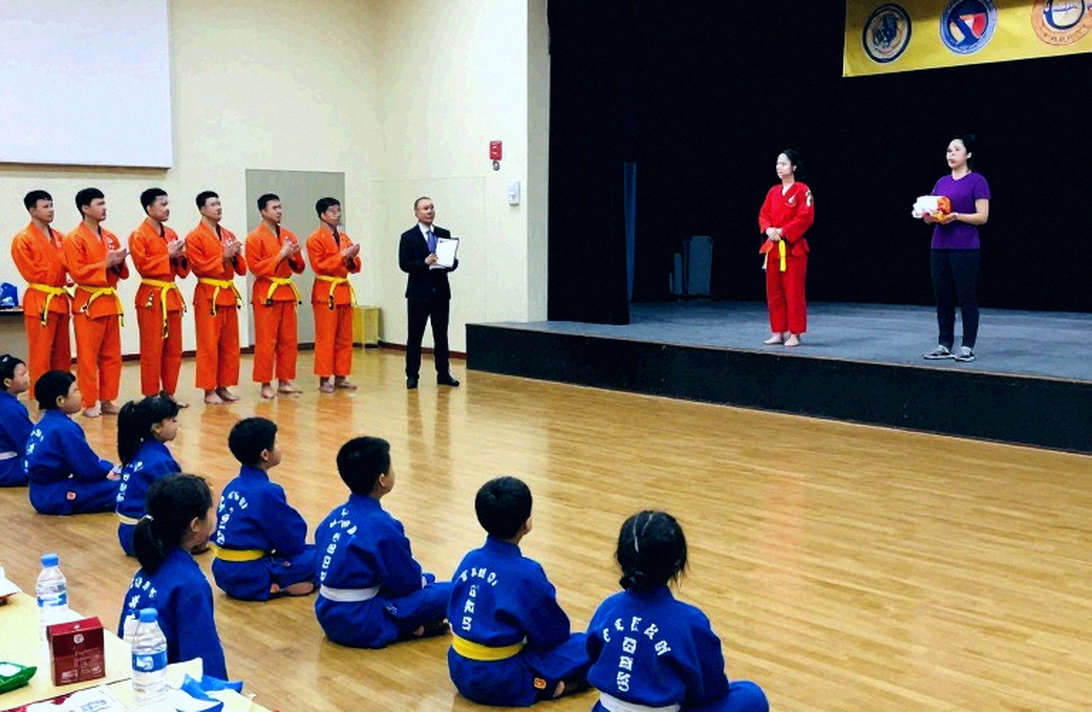
Preparation also sits inside the data frame. The delegation trained continuously in Ho Chi Minh City from the start of the year, then completed a camp in South Korea. This is a long preparation cycle, not a short-notice contingency. In a scoring discipline, where a millimeter of posture can decide a ranking, a long runway reduces the risk of technical error. It does not guarantee a medal, but it shifts the probability distribution in a favorable direction.
Every record has two pages: the published page and the hidden page. The published page of Vietnamese poomsae is three team golds. The hidden page is individual results, where opponent depth is far greater. South Korea's 17 golds come from individual depth plus home advantage. Chinese Taipei and the United States have stable individual development pipelines. Vietnam does not yet have an equivalent structure in single categories. So when we say Vietnam is "hunting gold" in Chuncheon, that must be read event by event, not as a challenge for the overall throne.

Now the contrarian part. A collective model sounds safe, but it holds three vulnerabilities rarely mentioned. First, a scoring discipline carries subjective risk from the judging panel. In a narrowly judged event, a small evaluation deviation can flip the result. With the event hosted in Chuncheon, the home advantage of the host nation becomes a variable to price in. Second, concentrating expectations on Chau Tuyet Van's two events makes one individual the pivot of the entire plan. Third, most of the standard U50 core is near the end of its competition window, raising a near-term succession question for the team events themselves. Data does not need fans; it only needs patient readers.
I must also state my own limits. In my tracking sheet, my individual predictions are wrong more often than my team predictions. In 2026, I overestimated the women's team probability because I ignored a compressed schedule variable. That mistake forced me to record it, rather than hide it, so readers see the cycle model is no magic wand. Every model has an error rate, and an honest writer must publish the part he got wrong.
Looking ahead, the question worth asking is not whether Vietnam wins, but which cycle will replace the current U50 core. The 2026 Asiad is the first checkpoint for the young freestyle pipeline. If the U30 pair keeps developing, they could carry part of the expectation by then. If not, the gap between the older and younger classes will show exactly when it is most expensive. Sport is a common language, but data is the accurate translation. And that translation only completes when the cycle closes — something no one in Chuncheon can confirm on competition day.